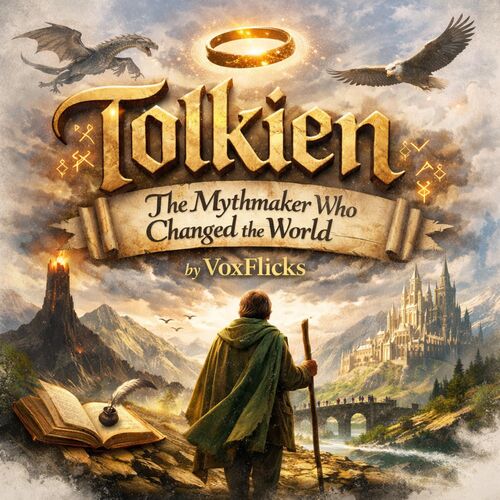
Tolkien's Lost Letters: The Untold Stories of Middle-earth's Creator
A literary giant biography, literary giant biography · book audiobook.A literary giant biography, literary giant biography · book audiobook.
Chapter 1: Secrets in the Ink...—
The story begins where most endings are written. In the quiet moments before everything changes. A stack of yellowed envelopes, sealed with wax long since hardened, rests on a desk in Oxford. The air is thick with the scent of old paper and ink, the kind that lingers in rooms where great minds have wrestled with words. These are not just letters. They are fragments of a legend still unfolding.
For decades, they lay forgotten. Tucked away in archives, buried beneath the weight of time. But now, as the world turns digital, they surface. The private writings of J.R.R. Tolkien—his doubts, his dreams, his battles with the stories that would shape a generation. And with them, the untold stories of Middle-earth’s creator.
The first letter is dated 1937. The handwriting is precise, deliberate, as if each word carries the weight of a kingdom. Tolkien writes of a world taking shape in his mind—a world of elves and dwarves, of rings and dragons. But there is hesitation. A fear that no one will understand. "I have written something," he confides, "but I do not know if it is worthy."
Oxford in the 1930s was a place of towering intellect and quiet rebellion. The spires of Magdalen College pierced the sky, and the streets hummed with the debates of scholars. Tolkien walked these paths, a man caught between two worlds—the academic rigor of his day job and the mythic landscapes of his imagination. His students saw him as a professor, but his true work was done in the margins of his notes, where dragons coiled and kings rose and fell.
The letters reveal a man at war with himself. A scholar who feared his fantasy would be dismissed as childish. A father who worried his sons would think him foolish. And yet, he could not stop writing. The stories demanded to be told. They whispered to him in the quiet hours, in the rustle of leaves outside his study window, in the flicker of candlelight on parchment.
One letter, written to his publisher, is particularly revealing. "I have begun a tale," he admits, "but I do not know where it will lead." The words are humble, almost apologetic. But beneath them, there is a current of something else—something fierce. A conviction that this story matters. That it must be told.
The letters are not just about The Lord of the Rings. They are about the man who wrote it. The boy who grew up in Birmingham, who lost his mother too young, who found solace in the myths of the past. The soldier who survived the trenches and carried the weight of war in his heart. The professor who taught Old English but dreamed in Elvish.
In one passage, Tolkien describes a vision that haunts him—a vision of a great tree, its roots deep in the earth, its branches stretching toward the heavens. It is a tree that will fall, he writes, but its seeds will scatter. And from those seeds, new forests will grow. It is a metaphor for his work. For the stories that will outlive him.
The letters also reveal the personal struggles behind the legend. The grief of losing his wife, Edith, and the way he poured his sorrow into the pages of his books. The loneliness of a man who felt misunderstood, even by those closest to him. And the quiet triumph of seeing his words reach readers who needed them.
One letter, written to a young fan, is particularly moving. The child had written to Tolkien, asking if Middle-earth was real. Tolkien’s response is gentle, almost wistful. "It is as real as you make it," he writes. "For some, it is a place of escape. For others, a place of truth."
As the letters unfold, a portrait emerges—not just of a writer, but of a man. A man who doubted, who struggled, who fought to bring his vision into the world. And in doing so, he created something greater than himself. A myth that would endure. A legacy that would outlive him.
The last letter in the stack is undated. The handwriting is shaky, the ink faded. Tolkien writes of his final days, of the stories he still wishes he could tell. "I leave them behind," he says, "like seeds in the wind." And then, a simple, heartbreaking line: "I hope they grow."
The letters are silent now. But their words echo. They whisper of a man who dared to dream. Of a world that was born from his heart. And of the stories that still wait to be told.
Chapter 2: Shadows of War and Song...—
The firelight flickers against the walls of Tolkien’s study, casting long shadows of books and maps. Outside, the distant hum of Oxford in the 1930s drifts through the window—carriages, laughter, the occasional shout of students. But here, in this room, the air is thick with something older. Something that lingers like the scent of parchment and ink.
Tolkien sits at his desk, his pen hovering over a page. The words do not come easily tonight. His mind is elsewhere—on the trenches of the Somme, on the faces of friends who never returned. And on the stories he must tell.
For Tolkien, war was not just a memory. It was a wound that never closed. The horrors of the battlefield had seeped into his bones, into his dreams. And from that darkness, something new was born.
The Shadow of the Great War
It was 1916 when Tolkien, a young officer in the Lancashire Fusiliers, found himself in the mud and blood of the Western Front. The world he had known—scholarly, quiet, full of myth and legend—was shattered. The trenches were a place of noise and silence, of screams and the eerie absence of sound. And yet, in the midst of it all, Tolkien wrote.
He scribbled poems in the margins of his notebooks, fragments of verse that would later become the foundation of The Lord of the Rings. The elves of his imagination were not just creatures of fantasy—they were his escape, his way of making sense of a world that had gone mad. In the trenches, he found the seeds of Middle-earth.
The Myth That Heals
After the war, Tolkien returned to Oxford, but the scars remained. He buried himself in his work, in the languages he loved, in the stories he had begun to weave. And slowly, he realized something profound: myth could be a balm.
In a letter to a friend, he wrote, "The only cure for the wounds of war is to turn them into stories." And so he did. The battles of Middle-earth were not just echoes of his own experiences—they were a way to confront them. The fall of Gondolin, the siege of Minas Tirith, the final stand at the Black Gate—these were not just tales. They were exorcisms.
The Weight of the Ring
But Tolkien’s war was not just personal. It was a reflection of something deeper—the struggle between light and darkness, between hope and despair. The One Ring, that cursed artifact, was more than a plot device. It was a metaphor for the corruption of power, for the way even the noblest of hearts could be twisted by fear and ambition.
In the quiet of his study, Tolkien often wondered: What would it take to resist such a force? The answer, he believed, lay not in strength alone, but in sacrifice. In the willingness to let go.
The Legacy of War and Myth
Today, as we sit in the quiet of our own lives, far removed from the trenches of the Somme, Tolkien’s words still resonate. His stories are not just about dragons and elves—they are about the human heart. About the way we face our own battles, about the myths we create to survive.
And perhaps that is the greatest lesson of all. That even in the darkest of times, there is always a story waiting to be told.
Chapter 3: Shadows of a Forgotten Love...—
The firelight flickers against the walls of Tolkien’s study, casting long shadows that dance like restless spirits. Outside, the wind howls through the Oxford spires, a mournful dirge that seems to whisper secrets of the past. Here, in this room, among the stacks of manuscripts and the scent of aged parchment, the weight of love and loss lingers like a half-remembered dream.
Tolkien’s fingers trace the edges of a letter, yellowed with time. The ink is faded, but the words are still sharp—sharp enough to cut. It is a letter from Edith, his beloved, written decades ago, when the world was younger and their love still untouched by sorrow.
"My dearest John," the words begin, and already, the voice in his mind is soft, trembling with the quiet strength of a woman who loved fiercely. He can see her now, standing in the garden of their first home, her hair catching the sunlight like spun gold. She was his muse, his anchor, the one who understood the depths of his imagination before the world ever did.
But love, as Tolkien knew all too well, is never without its shadows. The letter continues, speaking of small joys—the warmth of tea on a winter’s evening, the laughter of their children, the way the trees outside their window swayed in the breeze. But beneath the warmth, there is a current of unease. Edith’s health was failing. The doctors spoke in hushed tones, their words heavy with things left unsaid.
Tolkien closes his eyes, and for a moment, the study fades away. He is back in the hospital ward, the sterile air thick with the scent of antiseptics and despair. Edith’s hand in his is frail, her breath shallow. She smiles at him, that same radiant smile that had first captivated him as a young man, and whispers, "Don’t let the darkness take you, John. Finish the story."
The story. The great tale of Middle-earth, the one that had begun as a private world for his children but had grown into something vast, something alive. Something that demanded to be told. And yet, how could he write of love and loss when the weight of his own was so heavy?
The war had taken so much from him. Friends lost in the trenches, their voices silenced forever. The world had changed, and with it, the innocence of youth. But in the midst of that darkness, there was Edith. Her love was his refuge, his light in the endless night.
And then, one winter morning, she was gone. The house was too quiet. The letters stopped coming. The garden, once alive with her presence, stood bare and cold.
Tolkien sits alone in his study, the fire burning low. The letter trembles in his hands. He had written of love in his books—of Beren and Lúthien, of Aragorn and Arwen. But none of those stories could compare to the ache of his own.
Yet, in the quiet, he understands something. The stories were never just about the joy. They were about the pain, too. The loss. The way love lingers, even after the beloved is gone.
He sets the letter down, his fingers brushing the pages of The Lord of the Rings, still unfinished. Somewhere in the distance, a clock chimes the hour. The wind still howls, but now, it carries something else—a whisper of hope. A reminder that even in the darkest times, stories endure.
And so, with a deep breath, Tolkien picks up his pen. The firelight flickers, the shadows dance, and the tale continues.
Chapter 4: Where Myths Take Shape...—
The ink was still wet on the page when J.R.R. Tolkien first whispered the name Middle-earth into existence. It was not yet a world—only a spark, a flicker of something vast and waiting. But in that moment, in the hushed corners of Oxford’s libraries and the quiet of his study, the foundations of a legend were being laid.
Tolkien was not yet the man who would shape the fate of hobbits and elves, of rings and dragons. He was a scholar, a linguist, a man haunted by the echoes of ancient tongues. But something deeper stirred in him—a longing for a world that felt both lost and yet to be discovered.
The seeds of Middle-earth were sown in the trenches of the Somme. In the mud and the blood of the First World War, Tolkien had seen the worst of men. And in that darkness, he began to dream of something brighter. A world where courage was not measured in medals, but in the quiet defiance of a small people against impossible odds.
Back in Oxford, the idea took root. Not as a story, not yet—but as a language. Tolkien had always been obsessed with words, with the way they carried meaning beyond their letters. He began to craft his own tongues, Elvish and Dwarvish, before he even knew what they would say. The world would come later.
It was in the quiet of an autumn evening, the firelight flickering against the walls of his study, that the first true glimpses of Middle-earth emerged. Tolkien sat at his desk, a pipe in one hand, a pen in the other, and began to write. Not a story, not yet—but a myth. A creation tale, a song of the beginning of things.
He called it The Book of Lost Tales. It was raw, unfinished, a jumble of names and places and half-formed ideas. But within those pages, the first whispers of Middle-earth could be heard. The sound of waves against the shores of Beleriand. The rustle of leaves in the forests of Doriath. The distant call of a trumpet in the halls of Gondolin.
Tolkien did not set out to write a novel. He did not set out to create a legend. He only wanted to give voice to the languages he had invented. But the world had other plans.
The more he wrote, the more Middle-earth took shape. The more he explored its landscapes, the more real they became. The more he breathed life into its people, the more they demanded to be heard. And so, slowly, inevitably, the stories began to unfold.
It was not an easy birth. Tolkien struggled with doubt, with the weight of his own ambition. He was a scholar, after all—not a storyteller. And yet, the stories would not be silenced.
In the quiet of his study, surrounded by the ghosts of ancient texts, Tolkien began to see the outlines of a greater tale. A tale of power and loss, of friendship and betrayal. A tale of a world caught between light and shadow. And at its heart, a simple, terrible truth: that even the greatest of worlds could be undone by the smallest of choices.
The Birth of Middle-earth was not a single moment. It was a slow, deliberate unfolding—a revelation as much to Tolkien as it was to the world. And when, years later, The Hobbit and The Lord of the Rings would finally take flight, it would be with the weight of all those quiet, forgotten hours. All those nights spent bending over a desk, a man and his pen, and the world that only he could see.
And so, in the end, Middle-earth was born not from a single spark, but from a thousand small fires. From the flicker of an idea, the whisper of a name, the slow, steady hand of a man who dared to imagine a world beyond his own. And in doing so, he gave us all a place to return to. A place where the light still shines, even in the darkest of times.
Chapter 5: Secrets of the Forgotten Sage...—
The ink had barely dried on the final pages of The Lord of the Rings when the letters began to arrive. Not the fan letters—though there were many of those—but the letters that mattered most. The ones Tolkien never meant for the world to see.
They came in envelopes worn thin by time, their edges frayed from being opened and read again and again. Some were written in haste, others in the quiet hours of the night, when the weight of creation pressed upon him like a second shadow. And now, decades later, they are being unlocked.
This is the story of what they reveal.
---
Oxford in the 1930s was a city of whispers. The cobblestones hummed with the footsteps of scholars, the air thick with the scent of old books and pipe smoke. Tolkien walked these streets like a man carrying a secret world in his pockets. And in many ways, he was.
The letters begin in the quiet of his study, where the firelight flickered against the spines of leather-bound volumes. One, dated 1937, speaks of a moment that would change everything. "I have written myself into a corner," he confesses, his handwriting tight with frustration. "The story demands more of me than I ever imagined it would."
But it was not just the weight of the narrative that troubled him. It was the weight of legacy. The fear that what he had begun might outlive him. That it might become something he could no longer control.
---
The first drafts of The Lord of the Rings were a mess. Pages torn, rewritten, abandoned. Tolkien’s letters from this period are filled with doubt. "I am not sure I can finish this," he writes to a friend. "The tale has grown too large for me."
Yet, in the margins of those same letters, something else emerges. A quiet determination. A realization that the story was no longer his alone. It belonged to the world now.
---
One letter, written to his son Christopher, captures this shift perfectly. "You asked me once why I write," Tolkien begins. "I did not know the answer then. But now I do." "I write because the stories will not let me rest." "They are older than me, older than this age. And they will outlast it."
This was the moment Tolkien unlocked his legacy. The moment he understood that his work was not just a story. It was a key. A key to something vast and timeless.
---
The letters that follow are filled with wonder. Tolkien describes the strange sensation of watching his characters take on lives of their own. "Frodo is not mine," he writes. "He is his own man now. And I am only the one who listens."
This is the heart of the matter. The great creators—those who shape worlds—often find themselves shaped in return. Tolkien’s letters reveal a man who was both the architect and the witness. The one who built the door and then stood back to see who would walk through it.
---
But the letters also reveal the cost. The sleepless nights. The moments of despair. The fear that he had failed.
In one particularly raw passage, Tolkien admits that he nearly abandoned the entire project. "I thought of burning the manuscripts," he confesses. "Of letting the story die with me." "But then I realized—I was not the one who had written it."
This is the paradox of legacy. The thing that outlives us is never truly ours. It belongs to the future. And the future, as Tolkien knew, is always waiting.
---
The final letters are the most revealing. Written after the publication of The Lord of the Rings, they are filled with a quiet awe. Tolkien watches as his creation takes on a life of its own. As readers find meaning in it that he never intended. As the story becomes something larger than he ever imagined.
"I did not know," he writes, "that a tale could be a mirror. That it could reflect the hearts of those who read it. That it could become a home."
---
And so, the letters end where they began. In the quiet moments before everything changes. Before the world discovers Middle-earth. Before the legend is born.
But now, as we read these words, we understand something Tolkien himself may never have fully grasped. That legacy is not about what we leave behind. It is about what we unlock. And in unlocking it, we become part of something greater.
The story does not end with the last page. It only begins.
Select a chapter to view the transcript.